Eight Hours

A note before we start: this post is about sexual assault and the way we treat women who report it. If that’s not what you’ve got the stomach for today, I understand completely. Go and look at pictures of my chickens instead. I won’t be offended.

Eight hours.

That’s about how long it took. Victoria Police were called to a hotel in East Melbourne in the early hours of Monday morning, where the Sydney Swans were staying after a win that locked in a home final. By the time most of us had finished our first coffee, the story had already turned. Not into a question of what happened to a woman. Into a question of what kind of woman she is.

The photo was circulating. The innuendo was circulating. The words sex worker were being deployed the way people deploy them — not as a job description but as a verdict. Somebody had decided the salient fact wasn’t that a woman had walked into a police station and said the hardest sentence there is to say. The salient fact was that she was the wrong sort of woman to be saying it.

Eight hours. From complainant to punchline.

I’d like to tell you I was shocked. I wasn’t. I don’t think a single woman I know was shocked. That’s the part I keep chewing on, actually — not the outrage but the complete absence of surprise. We watched it happen with the resigned expertise of people who’ve seen the film before and know exactly which scene is coming next. Here’s the photo. Here come the theories about what she was after. Here comes the bloke in the comments explaining that women lie about this all the time, a thing he has never once bothered to check but feels in his bones. Here comes the concerned discussion about these young men and their careers, their futures, their tragic proximity to consequences.

And here — right on cue — comes the line that made me want to put my boot through the screen.

Men in a position of power should be given the benefit of the doubt.

Let’s take that one apart, because it deserves it.

The presumption of innocence is a real thing and a good thing and I’ll defend it until I’m hoarse. It belongs in a courtroom. It means the state has to prove its case against you before it can take your liberty. It is a shield held up between a citizen and the enormous crushing weight of the government, and it exists precisely because that weight is enormous and crushing.

It has never meant she is presumed to be lying. Those are not the same statement. They are not even in the same postcode. You can hold the position that these men have not been charged with anything and are entitled to due process — which is true, and which I hold — without also circulating a photograph of a woman and inviting the internet to appraise her. One of those is a legal principle. The other is a sport.

And the power part. The benefit of the doubt is supposed to run toward the person with less protection, not more. These are men with a football club, a league, a media department, a players’ association, lawyers on retainer and a nation of supporters who have loved them since they were teenagers. She has none of that. She has whatever’s left of her privacy and a phone that won’t stop going off. To look at that arrangement and conclude that the men are the ones in need of a bit of extra grace is not a moral position. It’s a fan reflex wearing a suit.

Meanwhile the actual institutional emergency, as far as I can tell, was that the All-Australian squad announcement had to be pushed back a week.

Here’s the bit I’ve been avoiding saying, so I’ll just say it.

If it were me, I don’t know that I’d come forward.

I’ve turned that over for two days and I can’t make it come out any other way. Knowing what I know, having watched this exact thing happen to this exact kind of woman over and over since I was young enough to think it would surely be different by the time I was old — no. I don’t think I’d pick up the phone. I think I’d go home, and have a shower I’d remember for the rest of my life, and tell nobody, and carry it.

That is what all of this is for. That’s the function. It isn’t a side effect of the noise, it’s the point of the noise. Every woman watching this week has been handed a very clear piece of instruction about what happens to women who speak, and she’s been handed it for free, in eight hours, without anyone having to say a word to her directly.

And I keep coming back to the count.

Sherele Moody keeps a ledger of Australian women and children killed by violence, because no government in this country has decided that’s their job. Thirty-seven women this year, and we were only in July when I last looked. Seventy-nine last year. More than thirteen hundred since 2000. She is one woman with a spreadsheet doing the work a nation won’t do, and she was also one of the voices this week saying plainly that what’s being done to this woman online is victim blaming and it is malicious.

We are told this is a crisis. It got called a national emergency from a podium in 2024. And then a woman reports an assault and within a working day the country’s instinct is to work out what she was wearing, what she does for a living, and what she stood to gain.

Now, someone will pop up here and tell me I’m conflating two different things. Domestic violence over there. Sexual assault over here. Different crimes, different causes, different fixes, stop muddying the water, love.

And they’re not entirely wrong. They are different, and the difference matters.

Domestic violence is a siege. It’s slow. It’s conducted by a man who knows your mother’s birthday and where you keep the spare key and exactly which sentence will land hardest, because he’s been taking notes for years. It doesn’t announce itself with a single terrible night; it arrives by degrees, in the shape of a rule, then another rule, until one day you realise you’ve redesigned your entire personality around not setting him off and you can’t remember when you started. Sexual assault can be one night. One person. Sometimes a stranger, more often not. A single act that reaches back and rewrites everything behind it and forward and rewrites everything ahead.

Different mechanisms. Different escape routes, if there are any. Different lies told, to others and to yourself.

They’re also exactly the same thing, and I’ll die on that hill.

Both of them come down to a man deciding that a woman’s no is a formality. A negotiating position. Something to be worked around, waited out, or simply ignored, because in that moment he has decided that what he wants is more real than what she wants. And both of them do it in the most personal place there is. Not your car. Not your wallet. Not a punch thrown in a pub car park in front of witnesses who’ll back you up. Your body. Your bed. Your own house, or a hotel room you can never un-know. The place you can’t lock the door on, ever, because you have to live in it for the rest of your life.

And then — this is the bit that seals it — the aftermath is word for word identical. Why didn’t she leave. Why did she go up to the room. Those are the same sentence in different outfits. What did she think was going to happen. What was she after. She’s got a history, you know. She’s not exactly a saint. Same script, same lighting, same audience nodding along. You could run the DV comments and the assault comments through a machine and it couldn’t tell you which was which.

That’s why the death toll belongs in a post about a hotel room. It’s not a digression. It’s the same road, further along.

You cannot fix the killing while the culture is still like this. They’re the same thing at different volumes. The bloke who thinks she’s probably lying and the bloke who thinks she’s probably his are drinking in the same pub. Every joke, every photo passed around, every well, we don’t know the full story deployed as a shrug rather than as genuine caution — it all goes into the same account, and women pay the interest.

Which brings me to the thing I’ve never worked out.

How do women still trust men at all?

Not rhetorically. I actually don’t understand it. We know the numbers. We watched this week happen. And yet we get into taxis and we go on second dates and we fall in love and we marry them and we have sons and we hand over our whole soft undefended lives on the assumption that this one, at least, is safe. Every day, millions of us, on credit, with no collateral and a truly appalling claims history.

I think it might be the bravest thing people routinely do and nobody’s ever called it courage. It gets called normal. It gets called love, or being sensible, or don’t be so dramatic.

There are good men. There are wonderful men — I know some, I’m related to some, I write entire books about the imaginary ones. That’s not the point and it never was. The point is that the trust is a gift, extended constantly, at enormous risk, and the very least the recipients could do is spend a week not demonstrating exactly why it’s a bad bet.

So how many? That’s my honest question and I don’t have a clever ending for it. How many have to die before shit actually changes. Thirteen hundred wasn’t enough. Seventy-nine in a year wasn’t enough. A national emergency declared on television wasn’t enough to stop a woman being turned into content before breakfast.

I don’t know what happened in that hotel. Neither do you. Neither does anyone with a keyboard and an opinion, and it’s not our job to know — it’s the police’s job, and then a court’s, and both of those should be allowed to do it properly.

But I know exactly what happened afterwards. We all watched that part live.


If any of this has landed close to home for you: 1800RESPECT (1800 737 732) is there, all day, every day.

A Research Trip. It Is A Research Trip. I Am Going To Keep Saying That.

Right. So I mentioned in the last post that something specific was coming, and that it explained the thermal underwear, and that I’d tell you about it properly another time.

This is another time.

We’re going to Canada.

We leave on the 30th of November. And before anyone gets excited on my behalf, I want to be very clear about the nature of this undertaking: it is a research trip. Wholly and entirely undertaken in support of my writing. There is no other reason. I have thought about it from several angles and I am confident this framing holds.

Here is the itinerary. You may draw your own conclusions and I would ask that you keep them to yourself.


November 30. We leave. Out of home and up to Sydney first, because you cannot simply leave from here. Nothing simply leaves from here. Getting off this island is a process with stages.

Then Auckland, and from Auckland to Vancouver, across an ocean that I have looked at on a map several times now and which does not get smaller no matter how long I stare.

And we arrive on November 30. The same November 30. We cross the international date line and it hands the day back to us like we’d left it on the counter. I have had this explained to me. I have nodded along. I have subsequently tried to explain it to someone else and heard my own voice tail off halfway through. I am simply going to get on the plane and let it happen to me.

Eight days on the ground. Which sounds generous until you see what we’ve done with them.


Because here is the actual shape of it.

We land in Vancouver. Then we get in a car and drive to Edmonton — which, for the locals playing along, is not a little jaunt. It is a proper day of driving. In December. In Canada.

We’re driving to Edmonton to watch the Washington Capitals play the Oilers on the 3rd.

Now, I want to be clear that I have credentials here. I have done Brisbane to Geelong to catch the Spirit — nineteen hours, one stage, no sensible stopping — and I have done it twelve times, which I think we can all agree is eleven times more than any reasonable person would. So I’m not frightened of a long drive. Long drives and I have an understanding.

But every single one of those nineteen-hour runs, the only chill involved was the air conditioning set to nipsicle. That’s my entire experience of being cold in a car: self-inflicted, reversible, and available at the touch of a dial. I have never once driven through weather that was trying to kill me. I suspect there is a meaningful difference between “big” and “big and also frozen“, and I am about to learn it personally, in the dark, somewhere in Alberta.

The next morning we get back in the car and go four hours to Calgary, where on the 5th we watch the Capitals play the Flames — in the Saddledome, in its final year. That one matters to me more than I expected it to. Buildings like that don’t get replaced, they get succeeded, and there’s a particular ache in walking into a place while you still can. I fully intend to be embarrassing about it.

And then another full day’s drive back to Vancouver, where on the 7th — and you will never guess this — we watch the Capitals play the Canucks.

The day after that, we fly home.


So to summarise: I am flying roughly as far as it is possible to fly, in order to sit in three different buildings in three different cities across five days and watch the same team play hockey, with two enormous drives wedged in between, and then I am immediately coming home again.

Research.

I write hockey romance. I have written a great deal of hockey romance. And I want to put something on the record here, plainly, because it is the single most damning sentence in this entire post:

I have never once set foot inside a hockey arena.

Not once. Never. I have written arenas I have never stood in. Road trips I have never taken. Rooms I have never smelled. The specific quality of cold that comes off the ice and settles on your forearms — I have described that with enormous confidence on the basis of absolutely nothing but video footage and the reports of kinder, better-travelled people.

At some point a person has to go and check.

That’s my story. I’m sticking to it. My accountant may have questions and I am prepared for them.


The other thing — the real thing, if I’m honest — is who I’m doing it with.

Karen is American, and she and I have been at this together since somewhere around 1998. That’s not a typo. That is longer than some of you have been alive, and it is certainly longer than any sensible person maintains a correspondence about imaginary people.

She has been through forty-eight of my novels. Forty-eight. Forty-five of which have never seen daylight outside my own very small circle — which is to say, outside Karen and Jo. There are manuscripts on my hard drive that only two other human beings on this planet have ever read, and both of those human beings will be in the car with me in December.

There are days I’m not entirely convinced Karen and I aren’t operating on the same brain with a very bad connection between the halves.

And in all those years we have conducted the entire relationship across a time difference that has never once been convenient for either of us. In December we will be in the same country. The same car. The same building. At the same time.

The plan — and I use that word loosely — is that in the down times we’ll get some words down. Between drives. In the evenings. In airports.

I want to be honest with you about how likely that is.

We will write. We will absolutely write. What we will not do is make words. There’s a difference, and if you’re one of us you already know it: making words is the part where you sit down and put sentences in a document and it is work. Making stories is the other thing. It’s two people in a car for eleven hours going but what if he doesn’t tell her and no, wait, go back, what if it’s the brother and building an entire cathedral of plot out loud that neither of you writes down, and both of you remember perfectly two years later.

We’re going to come home with a folder containing one paragraph and a list of things we’re definitely going to write about later. And it will have been the most productive trip of my life.

And Jo is coming with us — I’ve just realised I hadn’t mentioned that — which means there will be a third person in that car, listening to two grown women argue passionately about the motivations of people who do not exist. She’ll smile in that way she does. The perplexed one. The one that says I love you both and I have no idea what is happening here. Jo has read the forty-five too, mind you. She knows exactly who we’re arguing about. She simply retains the ability to be normal about it, which is a gift neither Karen nor I have ever possessed.

We’re bringing the laptops. On principle.


The cats, meanwhile, will be furious. Fifteen of them, abandoned in the run-up to Christmas, with no regard for their feelings. In my defence there is a shed out the back containing over a thousand cans of cat food, which in hindsight makes the August boat trip look less like an unhinged errand and more like strategic forward planning.

I’d like that noted too.

Where I’ve Been (Or: One Boat, Six Days, And Twelve Hundred And Forty Cans Of Cat Food)

Hello. Yes. I’m still here. I know it’s been quiet — a fortnight of quiet, in fact, which I’m told is long enough for people to start wondering. In my defence I wasn’t gone the whole time. I was gone Saturday to Thursday. The rest of the silence was just me, here, not writing anything down.

I’d love to tell you I’ve been off doing something glamorous. A writing retreat, perhaps, in a stone cottage with a view and someone bringing me coffee at respectable intervals. A research trip. A festival. Something with a lanyard.

No.

I went to Victoria to buy cat food.

I want to sit with that for a moment, because I think it deserves your full attention. I crossed Bass Strait. On a boat. Like a person with purpose. And the purpose was tinned meat.

Now, in my defence — and I would like the record to show that I have a defence, and that this time it comes with numbers — there are fifteen cats living at this stationhouse. Fifteen. That is not a household, that is a small municipality with opinions. Add to that the chickens, the ducks, the geese, and the guinea fowl (who I remain convinced are simply feathered alarm systems that occasionally lay), and what you have is less a home and more a fully operational feeding regime with a writer attached to it.

Buying for that lot in the ordinary way — a few tins here, a few tins there, whatever the local shelf has decided to stock this fortnight — is a slow bleed. It’s the kind of expense you don’t notice until you look at it properly, and then you sit down for a bit. So somebody said we should just do a big run, and somebody else agreed, and neither of us stopped to ask whether “a big run” ought to involve a vessel with a car deck.

Reader, we booked the boat. My sister came with me, and we took two cars. That should tell you everything about the scale of ambition at play here — we did not go over there hoping to fit things in. We went over there with capacity.

I’d forgotten what the crossing is like. There is a particular kind of person who sleeps beautifully on the Spirit and I am not that person. I lay there in the dark listening to the hull doing its thing and thought about the fifteen cats at home, presumably staging a coup, and the poultry, presumably fine, because poultry are always fine. Then Devonport again on the way back and that first proper look at the Tiers, which is the moment I always know I’m home, no matter how far I’ve been or how ridiculous the errand.

Now. The arithmetic. Because I know some of you are already composing a very gentle comment about how this cannot possibly have been worth it, and I would like to get in first.

One ferry crossing. Four nights’ accommodation. Twelve hundred and forty cans of cat food and forty bags of litter.

And after the entire cost of getting there and back and sleeping in between had been taken off the top — the boat, the beds, the lot — we were still one thousand six hundred and eighty-seven dollars ahead.

One thousand six hundred and eighty-seven dollars. I have read that figure many times now and it has not stopped being funny. I did not go on a holiday. I went on a procurement operation, and it paid for itself and then handed me change.

And then, having established that we were already there and already had two cars and had frankly stopped being sensible several days earlier, we went to Costco.

I don’t want to talk about Costco at length because I’m not sure I can do it justice, but I will say this: I came home with six months’ worth of baking ingredients. Six months. Flour, sugar, the lot. I have never in my life been six months ahead on anything, including deadlines, and yet here I am, structurally prepared to bake through whatever comes.

I also came home with forty-eight rolls of toilet paper for fifteen dollars.

Fifteen dollars. Forty-eight rolls. I showed our housemate when we got home and she made a noise I can only describe as reverent. There is a stack of it in this house that you can see from the hallway and I am not moving it, because I want to look at it.

We also, while we were over there and clearly beyond saving, bought clothes. Warm ones. Properly warm ones — coats and thermals and the sort of fleecy unmentionables that a person does not buy in Tasmania in August unless something specific is coming.

Something specific is coming. We’re going to Canada in December.

I’ll write about that properly another time, because it deserves its own post and because I suspect if I start now I won’t stop. But it does mean that a not insignificant portion of a car that was supposed to be full of cat food ended up full of thermal underwear instead, and I regret nothing.

And then — because apparently we hadn’t yet located the bottom of this particular barrel — we went to IKEA.

For flatpack furniture. Because who doesn’t love a good flatpack.

I want to be very clear that I typed that sentence with a completely straight face and it is a lie in every meaningful sense. Nobody loves a flatpack. Flatpack is a thing you agree to at a distance, in a warehouse, in a good mood, and then live to regret in a hallway at nine o’clock at night surrounded by dowels while somebody reads step fourteen out loud in an increasingly clipped voice. I know this. I have known this for years. I bought it anyway. There are boxes in this house now, waiting patiently, and we both know how that ends.

Both cars came home riding low. And I mean low. There was a moment on the ramp where I did some quiet mental sums about weight limits and decided, in the great tradition of this household, not to think about it further.

I should have thought about it further.

One of the cars — the one carrying the bulk of the cat food, because of course it was — got stuck on the ramp coming off the boat. Grounded. Immovable. Sitting there with a queue of vehicles behind it and me in the driver’s seat performing the internationally recognised sequence of Trying It Again But More Confidently.

A stevedore came and got it off for us.

He did not laugh at me. I want that on the record, because he had every right to and he did not. He simply assessed the situation with the calm of a man who has seen many things come off many boats, got in, did whatever it is they do, and delivered my car and its enormous cargo of cat food safely onto Tasmanian soil. Then he handed the keys back and said something kind about how full it was.

Sir, if you’re reading this — and you are almost certainly not — you handled that with more grace than I did, and I have thought about you several times since.

Here’s the part that got me, though.

I was gone from Saturday to Thursday. Six days of not being sat on while I try to write, not being woken at ten past four by a cat with a theory, not having to check every chair before I sit in it. And I came through the door expecting — I don’t know. Something. A greeting. A parade. Some acknowledgement that the woman who crossed an entire strait on their behalf had returned.

They looked at me.

That was it. A brief and unimpressed survey of my person, an assessment that I had not brought anything of immediate interest into the room, and then a return to whatever they’d been doing. One of them yawned. I want you to understand that I saw it happen and I have not recovered.

Then, of course, the cartons started coming in, and suddenly I was the most beloved woman in the southern hemisphere. Fifteen cats materialised from fifteen separate hiding places like they’d been summoned. Absolute devotion. Total loyalty. Deep, abiding love — for approximately as long as it took to open the first can.

So that’s where I’ve been. Not writing. Not particularly resting. Just moving an enormous quantity of tinned meat, kitty litter, flour and unassembled Swedish furniture across a body of water, because I have made a series of life choices and this is where they’ve deposited me.

Normal service resumes now. There are words waiting, and a manuscript that has been sitting quietly with its hands folded, being very patient with me.

And somewhere out in the shed, enough cat food, litter, flour and toilet paper to see out a modest siege — with an allen key on standby, in case the siege gets boring.

Research. It’s Called Research.

Well. We’re going to Canada.

November 30th to December 8th, if you want the specifics, and I can tell you exactly what we’ll be doing with that time: watching the Washington Capitals play three games. Edmonton. Calgary. Vancouver. In that order. In December. In Canada.

Now, before anyone says anything, I want to be very clear about something.

This is research.

I am a working author. I write hockey romance under the Bella Bruce name — an entire fictional league, the Portland Pioneers, a whole universe of men who are enormous and emotionally constipated and skate very fast. You cannot write that convincingly from a stationhouse in rural Tasmania on the strength of YouTube highlights and vibes alone. At some point, a serious professional has to go and stand in the building. Feel the cold come off the ice. Hear what twenty thousand people sound like when the puck goes in. Learn what the air smells like at a rink in an actual hockey country in actual winter.

That’s not a holiday. That’s fieldwork. I’ll be taking notes. There will be notes.

(Jo has been very supportive about the notes. Jo has also been laughing at me for approximately three weeks. Both things can be true.)

Why now

Because Ovi re-signed.

For those of you who don’t follow hockey and are only here for the cats and the kitchen renovation: Alex Ovechkin is the Washington Capitals’ captain, the greatest goal scorer the sport has ever produced, and — at the time of writing — a man of forty who has just put pen to paper for a twenty-second season with the only club he’s ever played for. He’d left it late. There was a genuine possibility he’d simply walk away, and honestly, nobody would have blamed him.

He didn’t. He signed. “I’m back!” he said, which is exactly the correct number of words.

And the moment that news landed, we looked at each other and said: right. Now. It’s now or it’s never. Because the thing about watching a legend play out the last of it is that there’s no schedule for when the last of it arrives. You don’t get a warning. You get one more year, maybe, and then one day you’re reading a retirement announcement and thinking I always meant to go.

I have too many of those already. I wasn’t collecting another one.

The plan

Three games, three cities, nine days, and a schedule that is — I’ll be honest with you — mildly deranged. The Caps are on a long western road swing through that stretch, and we’ve essentially chosen to become barnacles on the hull of it. Edmonton, then Calgary, then Vancouver on the 7th, and then home.

Now about Snow…

And now I have to tell you something a little embarrassing, which is that neither of us has ever seen snow.

I mean properly seen it. Seen it falling and staying. Seen it sitting on things — on a fence post, on a car roof, on a branch — being snow, in the way it does in every Christmas film ever made.

We’ve seen the miniscule flurries you get here occasionally, the kind that come down looking very promising and then vanish the instant the sun clears the hill, like they’ve remembered an urgent appointment elsewhere. And I once saw snow in Oregon, in spring, which I’d been quite excited about until I got close enough to establish that it was really more ice than snow — a sort of grey, granular, week-old business that had clearly given up on being beautiful some time ago.

That’s it. That’s the whole of my snow experience. Forty-odd years on this earth and I have never once stood in falling snow.

So somewhere in Edmonton or Calgary — and everyone assures me it’s a fairly safe bet in December — there is a very strong chance that two grown Tasmanian women are going to stop dead in the middle of a footpath, in the way of everybody, and simply stare upward with their mouths open like a pair of absolute tourists.

I’m not going to apologise for it. I’ve been waiting a long time. If you’re Canadian and you see us doing it, please just go around.

I am also told that Edmonton in early December is not cold in the way that we understand cold. Tasmanian cold is a damp, complaining sort of cold that gets into your knees. Edmonton cold, from what I gather, is a cold with opinions. A cold that takes an interest in you personally. We’re buying proper coats — real ones, not the optimistic Tasmanian approximation of a winter coat — and this has been budgeted for. It’s a business expense, obviously, because it’s research.

And the history

Because it can’t only be hockey — even I have limits, and Jo has conditions — we’re building the rest of the trip around actually seeing where we are. Museums. Old buildings. The bits of a country that tell you how it got to be the way it is. I’m the woman who once climbed a hill in New Zealand to stand where a film set used to be, so you already know I’m not going to be in Alberta and not go looking for what’s underneath it.

There’ll be a fair bit of that. There’ll be photographs. Given my track record with a certain tour group and twelve thousand photos of a fictional village, you should probably brace yourselves.

The honest bit

Here’s the truth of it, under all the joking about research.

I’ve been writing about this sport for years. I’ve built a league, filled it with players, given them lines and rivalries and terrible haircuts and love stories. And in all that time I’ve never once sat in a rink in the country that invented the thing and watched it happen in front of me.

That’s a gap. Not a fatal one — you can write around a gap — but I’ve always known it was there, sitting in the back of my head every time I described the sound of a body hitting the boards and had to imagine it.

So yes, it’s research. It’s genuinely research. It’s also nine days with my favourite person, in a country neither of us has seen, watching a forty-year-old Russian do the thing he’s better at than anyone who has ever lived, while there’s still time to watch him do it.

And somewhere in the middle of it, if the weather is kind — and by kind I mean appropriately unkind — I’m going to stand outside in a proper coat and watch snow come down and settle on things, for the first time in my life, at the age of far-too-old-to-be-this-excited.

Some research you have to go and get in person.

See you in December. I’ll bring back notes. And photos. So many photos.

— Suzy

The Closest I Ever Got to Sam Neill

Vale Sam.

Sam Neill has died, and I find myself unexpectedly wanting to sit down and tell you all a story.

He gave us so many good films over the years — more than I could possibly list, and every one of you will have your own favourite tucked away somewhere. Jurassic Park, obviously. The Piano. Hunt for the Wilderpeople. That particular brand of dry, watchful, slightly rumpled charm he brought to everything, where you always got the sense he found the whole business of being a film star faintly ridiculous and was quietly enjoying the joke. I liked him enormously, in the way you like someone you’ve never met but have watched be excellent for forty years.

But my best memory of the man isn’t from a screen at all. It’s from a paddock in New Zealand, and it remains, to this day, one of the funniest things I have ever witnessed with my own two eyes.

Let me set the scene for you.

Some years back I was on a Lord of the Rings tour through New Zealand. Now, I want to be clear about the calibre of people I was travelling with, because it matters enormously to what follows. We were not casual fans. We were not there to nod politely at a nice view, buy a fridge magnet, and be back at the hotel in time for the buffet. This was a fully immersive pilgrimage, and it was run like one.

The days were long. We’d often be up and moving before sunrise and still going late into the night, chasing the light, chasing the locations, chasing the exact spot where a thing had happened in a film that, to us, had rather more authority than most historical records. And here is the detail I really need you to sit with: a good number of my fellow travellers would set their alarms an hour earlier than they strictly had to — sacrificing sleep they desperately needed — purely so they could don their ears and their wigs, strap on their fake feet, and assemble each individual, painstakingly recreated piece of costuming, so that they might walk the paths of their chosen race properly attired. Not for a photo. Not for a laugh. For the integrity of the experience.

That was the calibre of devotion on that coach.

And it wasn’t only the dressing-up, either. This was a serious tour — run by Red Carpet Tours, in fact, and this same crew, plus or minus a few faces, has now done the whole pilgrimage twice — and it opened serious doors. We had lunch with the producers. We sat in on classes with the make-up artists who’d done the real thing. Weta Workshop opened their doors to us and let us stand among the actual artistry of it all. We were, in short, known. We were followed around by newspapers — and yes, I’m dating myself here, but this was back when newspapers were printed on paper and a photographer would trail a busload of costumed adults across the countryside because it made for a genuinely good story.

And speaking of photographs: when our group of twenty-five descended on Hobbiton, we came away with over twelve thousand photos between us. Twelve thousand. From one visit. To one location. We used to joke that no tour group on earth had ever documented a patch of ground so thoroughly — that entire professional survey teams had mapped smaller areas with fewer images. Every door of every hobbit hole. Every cabbage. Every artfully placed tiny wheelbarrow. If it existed in the Shire, we have it archived in triplicate from four angles.

Now, I’ll be honest with you: not every one of us was quite that far gone. There were some of us — and I count myself gently among this number — who were deeply, sincerely committed to the books and the films, but who had perhaps not crossed fully into the fake-feet-before-dawn tier of devotion. (And I mean that in the nicest possible way. I have nothing but love and admiration for the pre-sunrise wig people. I simply also enjoy sleep.) But committed tragics, one and all. That’s the important part. Whether we were in full regalia or merely in spirit, we took our roles seriously. Possibly too seriously. Definitely too seriously.

And lest you think I’m exaggerating the depth of it for comic effect — I’m really not. Here is the proof of the pudding: two of our bravest of men, the very fellows who served as our tour’s own Boromir and Aragorn, now work for Weta as weaponsmiths. Actual weaponsmiths. Forging the actual blades. And two of our hobbits went on to join Weta as costume experts. Four of the people on that coach were so genuinely, unshakeably good at this that the wizards behind the curtain took one look and hired them. So when I tell you we were a serious bunch, please understand I am not being cute about it. We were a pipeline.

So there we were, early one particular morning, being told with a certain amount of ceremony by our lovely guide that this afternoon we’d be making a special stop at Sam Neill’s favourite café. Not far, apparently, from his winery. There was a pause, clearly designed for a ripple of excited murmuring to pass through the coach.

The ripple did not come.

We took this news entirely in our stride and carried on regardless, because — and I say this with the greatest affection and no small amount of shame — poor Sam meant very little to a coachful of Tolkien obsessives. We had bigger fish to fry. We had Rohan to think about. This was a group that would rise before dawn to correctly attach a pair of pointed ears; a café patronised by a knighted New Zealand screen legend simply could not compete, in that moment, with the promise of another paddock that had once, briefly, in a certain light, been Middle-earth.

I’m not proud of it. But I’m not going to lie to you either.

When we finally arrived, the group split neatly in two. Some of us descended on the café like a clan of hobbits who’d caught the scent of second breakfast and would not be stopped by man nor Nazgûl. And a few of us — myself included — stayed behind on the coach.

Now, in my defence, I had earned that rest. We all had. It had been a big day. We had made the climb up to the site of the Golden Hall — where Éowyn stands watching the riders return to Rohan — and stood at the top waving the very flag the Fellowship carried, the wind doing its level best to tear it out of our hands. And here is the part that still makes me laugh: I found that climb genuinely difficult in ordinary human shoes, with ankles and arch support and all the advantages of modern footwear. The hobbits did it in silicone hairy feet. Silicone hairy feet. Up a steep, windswept hillside. And they did it without complaint, because to complain would have been to break character, and one does not break character on the paths of one’s chosen race. I have never simultaneously respected and worried about a group of people more.

We had also recreated the Charge of the Rohirrim across a hillside with more commitment than dignity. And we had spent a genuinely alarming amount of time on our hands and knees searching for Pippin’s Elven brooch, which one of our number had dropped and which had assumed, in our collective imagination, the significance of an actual plot point. We were spent. Emotionally, physically, spiritually. We slumped in our coach seats like the survivors of a great battle, which, in our heads, we absolutely were.

Little did we know that we — the exhausted, the seated, the ones who couldn’t be bothered — were about to receive the revelation of the entire tour.

Because as we sat there, a battered old SUV pulled up a little way off from the coaches. Nothing flash. The sort of car a man drives when he has nothing to prove to anybody and a winery to get back to. And out of it climbed a man.

I will never know precisely what tipped him off. I’ve turned it over many times since, and I like to imagine it unfolded slowly, the way dread always does in the films he was so good in.

Perhaps it was the fellow in full Boromir regalia, sword and all, slurping contentedly on a vanilla latte outside the café. Perhaps it was the Elven princess serenely demolishing a vanilla slice, crumbs cascading down her ethereal robes. But more likely — almost certainly — it was the three ginger hobbits who chose that exact moment to come clomping merrily out of his favourite café on their great fake hairy feet, chattering away, utterly at home.

Whatever it was, I watched it land.

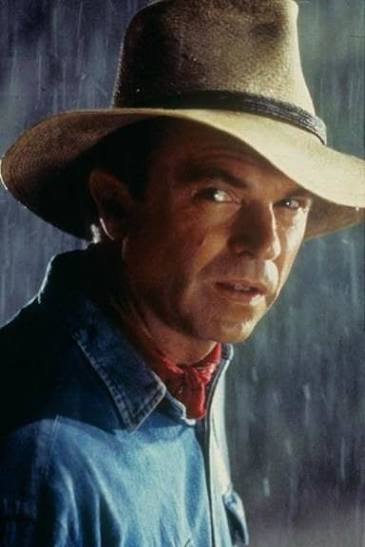
The man went still. He slowly reached up and took off his glasses. And his eyes went wide — and I need you to understand that this was not a general sort of wide. This was specific. This was, to the millimetre, the exact expression Dr Alan Grant wears when he first stands up in that jeep and claps eyes on the dinosaurs. That pure, silent, slack-jawed awe. That “we’re going to make a fortune with this place” face. Except in reverse. Except the wonder was horror, and the dinosaurs were us.

And then, without a single word, Sam Neill — knight of the realm, national treasure, the man whose café this was — gently sank back down into his battered SUV, quietly closed the door, and reversed out of there in a magnificent cloud of gravel dust. Gone. Vanished. Fled his own regular haunt rather than face a busload of feral Tolkien enthusiasts eating pastries in cosplay.

I have never respected a man’s survival instincts more.

That was the closest I ever got to Sam Neill. Not a handshake. Not an autograph. Not even a hello. Just the fleeting, unforgettable privilege of watching a genuine legend decide, in real time, that whatever was happening at his café today was Not For Him — and remove himself from it with the speed and decisiveness of a man who has clearly outrun a velociraptor before and knows exactly how these things go.

And do you know what? I wouldn’t trade it. A handshake, I’d have forgotten. That, I have dined out on for years.

Rest easy, Sam. Thank you for the films, thank you for the wine you probably poured extra generously the moment you got home that afternoon, and thank you — most of all — for the retreat. You clocked the situation, you made the right call, and you got out clean.

Life, uh, finds a way. 🍷
The Cat Who Walked Home

Things have been quiet on the stationhouse front lately — quiet in that particular way that only means the chaos has moved indoors. We’re having the kitchen renovated, you see, which sounds very grand and civilised until you realise what it actually means in practice: we are currently washing the dishes in the bathroom sink and eating anything that doesn’t require the application of heat. Salads. Cheese and crackers. Bread with things on it. The occasional triumphant assembly of a sandwich so architecturally ambitious it deserves its own blog post.

We do have the microwave, of course, still faithfully humming away in the corner like the last soldier at a forgotten post. Whether what it does to a bowl of leftovers counts as cooking or merely irradiating remains a matter of some philosophical debate in this household. I lean towards the latter. The food comes out hot in some places, glacial in others, and vaguely resentful throughout. But it’s warm-ish, and at this point warm-ish is a luxury we take gratefully.

In the evenings, with the kitchen a construction site and the ambitions of the day duly lowered, we’ve been making our steady way through Supernatural. We’ve reached season thirteen now, which is a genuine achievement of endurance for all parties involved — us and, one imagines, the writers. The production quality is still holding up beautifully, I’ll give them that. But the stories. Oh, the stories are getting weird. And I say that as someone who signed up for a show about two brothers who hunt demons in a muscle car. When the premise is already that unhinged and the plots still manage to make you tilt your head and go “…sorry, what?” — well. You know you’ve come a long way.

But the real news of the week, the thing I actually sat down to tell you about, is this: Bullwinkle came home.

Some of you may remember Bullwinkle. About eight months ago we made the difficult decision to rehome him. He came to us the way so many of ours do — born to a feral little half-Bombay who arrived at our rescue already pregnant, and we kept him ourselves because even though he had a wild streak a mile wide, he loved us. Or rather, to be perfectly honest, he loved Jo. I was tolerated. Jo was worshipped.

Back when we were up in Queensland, Bullwinkle was a happy boy. He spent his daylight hours out in the paddocks, living his best life among the cows, playing at being a very small and slightly deranged member of the herd. But when we moved down here to the stationhouse, something in him wanted out. He became a furred Houdini. A door only had to open the barest sliver and he was gone. We’d be walking out ourselves and he’d come rocketing between our ankles, a small determined missile intent on tripping us into an early grave. It wasn’t safe — not for him, not for our necks.

So we gave him to a young lad who’d often visited us and whom Bullwinkle adored. That boy could not so much as stand still without Bullwinkle wrapping himself devotedly around his legs. The lad had property. Room to roam. Cows, even, I think. It seemed like the kindest thing we could do for our adventurous little man — send him somewhere he could be as free as he so clearly needed to be.

And then life did what life does. The young lad was sent to live with his mum down in Victoria. And ever since, we’ve been quietly trying to work out how to get Bullwinkle back home where he belongs.

Turns out we needn’t have troubled ourselves. Bullwinkle 41

Khad his own plans.

He arrived home on Monday.

Now, I want you to sit with the geography of this for a moment, because I’ve had all week and I still can’t quite get my head around it. He travelled twenty-five kilometres. He crossed a major highway. He crossed two main feeder roads. He navigated country he’d been driven through, not walked, and only the once. And he did all of it, every single perilous kilometre of it, and turned up on our doorstep looking as sleek and handsome and infuriatingly pleased with himself as the day he left. Not a scratch on him. Not a hair out of place. Just Bullwinkle, home, as though he’d only popped out for the afternoon and couldn’t understand what all the fuss was about.

I don’t know how he did it. I don’t know how any of them do the things they do. But I know that some part of that small feral heart had decided where home was, and no highway, no distance, no sensible odds were going to argue him out of it.

There was, of course, one small complication in all of this. Jo — the sun around which Bullwinkle’s entire universe orbits — is up in Queensland at the moment. So, the grand reunion happened over FaceTime, which is a sentence I never imagined typing about a semi-feral cat. I held up the phone, Bullwinkle stared into it with those unblinking eyes, and Jo cried. Properly cried. And I’ll admit I got a bit wobbly myself, though I’ll deny it if pressed. Whether Bullwinkle understood that the small glowing rectangle contained his beloved I couldn’t tell you, but he sat there and listened to her voice, tail twitching, and that was enough for both of us.

He’s asleep as I write this, one paw over his nose, the whole twenty-five kilometres already forgotten. Fifteen-odd cats in this house and somehow there’s always room for one more — especially when he’s gone to that much trouble to be counted.

But here’s the thing that’s really got me, the part that turns a happy story into something that sits right down in your chest. Because as much as this is Jo getting her Bullwinkle back, it’s more than that. It’s Chookie getting her brother back.

You have to understand — there were three of them, once. Three kittens who grew up together at the same time: Chookie, Bullwinkle, and Rocky. None from the same litter, but littermates in their hearts. And Rocky. Oh, Rocky. He was born with cat flu and had a stroke when he was still tiny, and I bottle-fed that little scrap of a thing, taught him how to use the litter box, carried him around tucked into my bra for the first three months of his life like I’d sprouted a third boob. He was mine in the way the fragile ones always are. We lost him not long after we moved down here, and there’s a Rocky-shaped hole in this house that never quite closed over.

So when we gave Bullwinkle away, Chookie lost the last of her real brothers. And she’s been lonely ever since — that flat, quiet kind of lonely you can see in an animal if you’re paying attention. She had us, she had the crowd of other cats, but she didn’t have her people, if you know what I mean.

The first night Bullwinkle was back, the two of them curled up together and slept like the last eight months had never happened. Like no highway had ever separated them. And now they both have their friend again — the one who remembers Rocky, the one who came from the same beginning.

Welcome home, Bullwinkle. You mad, magnificent creature. We won’t be opening any doors too wide for a while — and we’ll have you and Jo in the same room again soon enough. But I think Chookie’s the one who was waiting for you all along.

The Ice Rink That Used to Be My Yard

Right. Hello. I’m alive. Just — hibernating, basically.

I’m not going to pretend I have a good excuse for going quiet. The truth is it’s been cold and grey and relentlessly, insistently wet here in Tasmania, and I have discovered that when the weather is sufficiently miserable, my entire personality collapses into approximately three-metre radius around the fireplace. If it’s not within that radius, it doesn’t exist and I have no opinions about it. The outside world? Theoretical. The writing? Getting done, somehow. Leaving the house? A concept for bolder souls.

The animals have, as a group, been coping poorly with this arrangement.

The chickens have become a roving disaster. The yard is so slippery that they’re basically surfing between the garden beds, absolutely soaked, wildly offended that the sky keeps doing that wet thing, refusing to go inside and shelter, and loudly blaming me personally. The ducks, characteristically, are having the time of their lives. Geese are somewhere in between — philosophical about the rain, opinionated about the mud, unhelpful in every situation.

Then there are the sheep.

We’ve been hosting seven of them while they mow the lawn, which has been working out extremely well, right up until the afternoon I needed to get the car out of the driveway. I opened the gate just enough to squeeze through, which one sheep immediately interpreted as a personal invitation. Out he went. Fine — I thought — I’ll just circle around and push him back in. Logical. Sensible. What happened instead is that the remaining six, who had been watching this development with great interest, collectively decided that this was the moment. All of them. Through the gate. Down the street.

Which is how my neighbour and her five-year-old daughter ended up rounding up seven entrepreneurial sheep as they made their way through the main street of the village. They were absolutely magnificent about it, both of them. The sheep made a brief detour through the neighbour’s yard — seemed to feel it warranted inspection — and then, miraculously, the whole situation resolved itself much faster than it had any right to. Everyone back in. Gate secured. The five-year-old was thoroughly impressed by the entire performance and has since asked when it will happen again.

I didn’t have the heart to tell her I’m doing my absolute best to make sure it doesn’t.

Yesterday was partly sunny. Today is actually sunny. The ice rink is slowly becoming a yard again, which is good news for everyone involved, including the chickens, who remain very angry about the whole season.

On the writing front, because things have quietly been happening even while I was crouching by the fire pretending to be a comfortable medieval peasant: the developmental edits and line edits are done on the first three books in both the Pioneers and the Compass Point series. I’m half through the first draft of the magical realism and the first rural romance. Which means the first three books in each series are down to final proofreading only — and then it’s just the remaining forty-five and thirty-seven respectively to see through. Only. Only. Artwork is happening too, which means things are genuinely, really, actually moving, even if I’ve been doing it from the general vicinity of the hearth rug.

Jo went back to Queensland on Saturday and is reportedly finding it considerably warmer. Given that I watched her leave into the horizontal rain, I can only imagine.

The fire and I are doing fine.

More soon. 🖤

Well. Here We Are.

Hello, hello. It’s been a minute. Or possibly several minutes. Time has lost most of its meaning this past week and I’m choosing to blame the weather.

We’ve had the kind of Tasmanian winter days that feel less like weather and more like a personal opinion the sky has formed about you. Grey pressing down from all directions, rain that can’t decide if it wants to be dramatic or just persistently miserable, wind that rattles the old station house windows in a way that suggests the building has something to say and is working up to it. The cats — thirteen of them now, which is a sentence I am not yet fully at peace with — have been performing collective judgement from various soft surfaces. The geese have opinions. I’ve had very little motivation to argue with any of them.

I’ve also run out of my ADHD medication, which — if you know, you know. The scaffolding just quietly disappears and you’re left standing there blinking, vaguely aware that there was a thing you were going to do, possibly several things, possibly an entire career’s worth of things, and somehow none of them are happening. I keep meaning to fill the script. I will fill the script. This is me making a promise in public so I actually do it.

In the meantime I’ve been sleeping until what can only be described as the afternoon, waking up to find the morning has fully left without me, and spending the daylight hours doing a very convincing impression of someone who is resting intentionally rather than someone who has simply misplaced their operational software.

The author socials have slid. The Bella and Avery and Tara feeds that I had very carefully been nurturing back to life are sitting quietly on their respective platforms, not bothering anyone, probably fine. I’ll find them again. Right now I’m in the mode where I know the work is there and I know I’ll get back to it and I’m trying to be kind to myself about the gap rather than catastrophising.

Trying. Being kind to yourself is its own kind of work, it turns out.

The bright spot: the author copies of Almost Yours Again — Avery Beckett’s latest — arrived today, and tomorrow Bella Bruce’s Isolated is apparently on its way, which means by the end of the week this table is going to be significantly more stacked with books that have my words in them.

I held Almost Yours Again in my hands. A real physical object with a spine and pages and everything. I love it. I love it the way you love something you made when you weren’t sure you could, the way you love a thing that exists now when once it only existed in your head. I put it on the table and kept picking it up and putting it down and picking it up again. The cats remained unimpressed. Jo said it looked lovely. I cried a little, which is allowed.

And then, inevitably, the fear arrived alongside the love. What if nobody else loves it? What if the thing I made that feels precious to me lands in the world and the world just continues being the world, unmoved?

I don’t have an answer for that fear. I’m sitting with it. I expect most writers sit with it for the entirety of their careers, so at least it’s good company.

The other thing I’ve been sitting with — and this one is a different flavour of nerve-wracking — is an idea that’s been circling for a while. I’m working up to approaching the Community Progress Association about the possibility of putting together a small Writers Festival in town next year. Something local, something that celebrates Australian romance authors and the people who love them, something that fits the specific shape of where we live rather than trying to be a scaled-down version of something bigger somewhere else.

I haven’t done it yet. I’m in the screwing-up-courage phase, which for me involves a lot of internal rehearsal of conversations that may or may not go anything like how I’ve imagined them. But I think it’s a good idea. I think the town could hold it. And I think — if I can just get myself out the door and into the room — I might be able to make the case.

Watch this space. Or watch me continue to rehearse for another fortnight and then suddenly do it all at once. Either is possible.

— Suzy writing from the old station house, Tasmania, where thirteen cats currently disagree about who owns the good armchair

Sheep, Chaos and Eleven Days

It has been a full day at the old police station and I am going to tell you about all of it.

First, the writing update, because some of us are allegedly professional: the monthly blog posts for Tara and K.S. Buckley are done, Bella has a new post in the world, and there are eleven days until Isolated hits the market. Eleven. I am choosing to feel good about this rather than spiral, and I am succeeding approximately sixty percent of the time, which I consider a passing grade under the circumstances.

Now. The weather.

Today’s rain was not yesterday’s rain. Yesterday’s rain had conviction. Yesterday’s rain knew what it was doing and committed to it, offensively and without apology. Today’s rain was something altogether more Tasmanian — that particular coastal mist that means well, genuinely means well, but cannot find it within itself to either stop or be real rain. It is not enough to justify staying inside. It is not enough to require an umbrella. It is exactly enough to ensure that anyone who ventures outdoors comes back damp in that slow, creeping way that takes you a while to notice and longer to fix.

It is also, as I discovered during my outside adventures, exactly enough to render certain shoes entirely decorative.

I spent most of the afternoon feeling like I was on roller skates. Well-lubed roller skates. The kind with no brakes and an opinion about where you’re going regardless of your own preference on the matter. I remained upright for most of it through a combination of core strength and dignity I didn’t know I had. The mud had other ideas on at least one occasion and I will leave it at that.

And then there are the sheep.

We have seven of them at present, using our yard as what I can only describe as a bed and breakfast. Temporary guests. Passing through. Absolutely delighted with the accommodations, or so I assumed right up until this afternoon when they let themselves through one of the gates — by themselves, without assistance, apparently having worked out the latch through a combination of curiosity and structural disrespect — and went on an adventure of their own devising.

We chased them around for a bit. On the aforementioned well-lubed roller skates. I will not go into further detail. What matters is that order has been restored and the gate situation has been reconsidered.

The poultry watched the entire event with what I can only describe as tremendous satisfaction. They have been cooped up and fenced in and generally managed for weeks and watching someone else get chased around the property for a change clearly brought them great joy. I have no notes. I would have done the same.

And then there is braincell number two.

Big. Floofy. Ginger. Magnificently, implausibly fluffy in the way that suggests he may be approximately forty percent more cat than is strictly necessary. He has discovered the sheep and is processing this information in real time — oscillating between complete fascination and barely contained terror with the frequency of someone who cannot commit to either response but refuses to leave the situation. He cannot look away. He also cannot go any closer. He is simply there, enormous and fluffy and vibrating with conflicting feelings about hoofed things.

And then one of the sheep bleated.

I want to be precise about what happened next because it deserves accurate documentation. He did not simply startle. He did not flinch or skitter or perform the standard surprised cat retreat. What he did was something that can only be described as an almost-backflip — a full-body reversal of opinion executed at considerable speed, all four limbs briefly expressing different views about which direction to go, his magnificent floof temporarily achieving a volume I did not know was possible. He was, for one glorious moment, a ginger explosion of secondhand thoughts about sheep.

He recovered his dignity. Eventually. He would like you to know he was never frightened. He was simply reassessing.

The sheep were unbothered.

I find all of this extremely relatable.

Eleven days.

🖤 🏒

Frightful Weather, Small Consolations, and Amazon Being a Dragon

The weather today was, in a word, awful.

In more words: the rain was insistent and relentless and entirely without charm, the kind of rain that doesn’t have the decency to be dramatic about it and just settles in with its bags unpacked and its feet up, prepared to stay indefinitely. There was nothing delightful about any of it and I say that as someone who does not, in principle, object to rain. This was not rain you could enjoy from a window with a cup of tea. This was rain that was making a point.

I had to go to town anyway because groceries do not materialise simply because the weather is demoralising, and the drive was exactly as hairy as the sky promised it would be. I made it there. I made it back. The house was rewarded for this act of meteorological bravery with Subway for dinner, which is not nothing. Some days the consolation prize is genuinely consoling.

The cross stitch subscription box arrived, which is exciting and being treated accordingly — which is to say it’s sitting there looking full of potential while I decide the right moment to open it properly. These things deserve the right moment. I’ll know it when I find it.

In the meantime I have been making a colouring book.

This is for the Meandering Book Nook — the wandering bookshop project, for those just joining us — and I’m not entirely sure yet whether it will become a regular fixture or whether it will remain an occasional thing. My instinct says occasional themed colouring books are probably going to be a permanent feature of the Nook’s life, because they feel right in a way that is difficult to articulate but easy to act on. We’ll see how the first one lands and go from there.

And then there is the other thing.

I would like to report that Isolated is out in the world and Bella Bruce’s author page is live and everything is proceeding beautifully on the hockey romance front. I would very much like to report that. Unfortunately what I am actually reporting is that Amazon has decided to be an absolute bitch about the whole thing and is currently sitting on both the book approval and the author page like a very bureaucratic dragon on a very unhelpful pile of gold.

I don’t have details beyond that. There are no details beyond that. There is just the waiting and the refreshing and the particular helpless frustration of having done everything right and then handed the whole thing to a platform that operates on its own timeline and its own logic and does not particularly care about your release schedule or your nerves or the fifteen years you have been carrying these characters around in your heart.

Bella is stalled. Her boys are waiting. There is nothing to do about it right now except wait.

So I am doing what writers do when one door slams shut on them: I am wandering through the other rooms. There are other projects. There are always other projects when you have three pen names and approximately a hundred books in various states of completion, and right now that particular abundance is genuinely a comfort. Something is always moving forward even when something else is stuck.

It is not the forward motion I wanted today.

But it is forward motion, and I am choosing to count it. Amazon will sort itself out. Or it won’t and I’ll have to go a few rounds with it, which is a battle I will fight when I get there. For now — other projects, more tea, a colouring book taking shape on the table, and a cross stitch box waiting for its moment.

And the cats, who are blissfully unbothered by publishing platforms and have, as ever, the right idea.

🖤 🏒