This morning looked promising. I want to be clear about that — I woke up with genuine optimism and a list and everything. The day had other ideas, as days around here tend to, and by the time I’d finished my first cup of tea the showers were already building on the horizon with that particular Tasmanian determination that means they’re not going anywhere in a hurry.
So. Inside day it is.
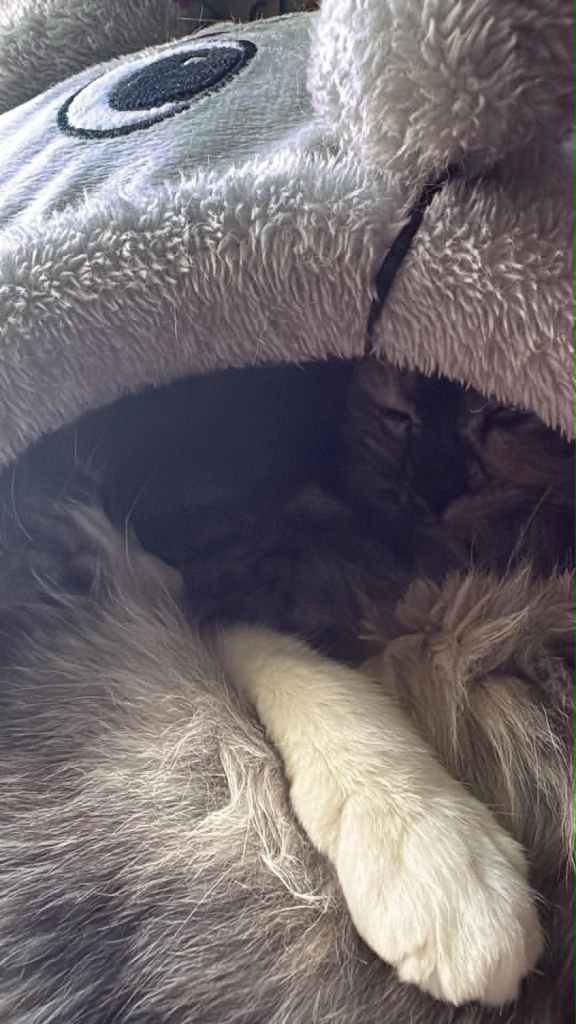
The Pusheen situation continues to develop in unexpected ways. Miss Hopalong, having apparently decided that possession is nine tenths of the law, has dug in with a commitment that I find frankly impressive. She has abandoned her spot by the fire — which, if you know cats, you will understand is not a sacrifice made lightly — purely to maintain territorial control of the Pusheen. Pretty is presumably circling. Hopalong is unmoved. The fire burns unoccupied. Some battles are worth the cost.
My plan for today was websites. Both of them, ideally, with enough momentum to make a meaningful dent in the approximately seventeen things that need doing before launch. What actually happened was that a small ginger braincell attached himself to my dominant arm with the quiet certainty of someone who has made a decision and will not be revisited on the matter, and so I adapted (because he was Mumu’s brother and he’s grieving), as one does, and spent the time performing the last edit run on Isolated instead.
Which means the hockey romance may be done sooner than expected. Which means breathing space before the marketing push on the military romance. Which is, genuinely, good news.
And yet. Marketing.
I knew writing was work. I have always known writing was work — I have the manuscripts and the late nights and the four-in-the-morning rewrites to prove it. What I did not fully appreciate, and what is becoming clearer to me with every passing day, is that the writing is actually the easy part. The writing is the part I know how to do. The marketing is a learning curve that appears, from where I’m standing, to extend well beyond the visible horizon in both directions.
There is also the small mystery of why one of my author blogs does not appear to be picking up subscribers the way the other one is. My sister’s theory is that hockey romance is simply the flavour of the month and that explains the discrepancy entirely, and she may well be right. But I have that nagging feeling, the one that sits just behind your sternum and won’t be argued with, that I am doing something wrong and I haven’t identified it yet. I’m not going to catastrophise about it. I’m just going to quietly suspect myself until I figure it out.
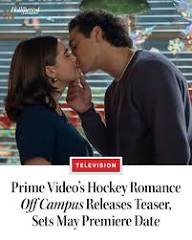
I watched the first episode of Off Campus last night.
Before I say anything else, let me be clear about something: I idolise Elle Kennedy. Have done since I read the Out of Uniform series, which is when I understood exactly what she was capable of, and from that moment I have made grabby hands at everything she’s written. The woman is a giant of this genre and I say that with complete sincerity and zero caveats.
Which is precisely why I want to like the show. I really do. The cast is lovely — every single one of them — and the people in their orbit are well played and I have no complaints about the performances on an individual level.
But.
You heard that coming, didn’t you.
Here’s the thing. When Heated Rivalry wrapped its first season, some intrepid reporter announced that Off Campus was on its way as a replacement. A successor. The next hockey show to fill that particular gap.
No. I’m sorry. It really isn’t. And not just for the obvious gay-versus-het reason, though that’s obviously significant. This is something else.
Heated Rivalry was shot on what I can only describe as the most heroic shoestring budget in recent television history. Two cameras. Two complete unknowns in the lead roles — we didn’t get a recognisable face until episode three. And those two? They had chemistry that sizzled on the screen even when they were supposed to hate each other. Especially when they were supposed to hate each other. That’s the thing about rivalry done right — the friction is the heat, and if you can feel that heat in the middle of open hostility then you’re in extraordinary hands.
Off Campus has a larger budget. More established names. Better resourced in every technical sense.
And the two leads had no chemistry for me. None that I could find, anyway. I kept waiting for it and it didn’t arrive. The character I found myself genuinely interested in was the FMC’s best friend, and one of the MMC’s teammates — which is a lovely sign for the future of the supporting cast and a slightly worrying sign for the central romance, which is, after all, the engine the whole thing runs on.
Here’s my possibly controversial take: the budget increase didn’t do Off Campus any favours. There’s something about a small production that has to rely entirely on performance and chemistry that can produce something extraordinary when it works. When it doesn’t have the money to dazzle you, it has to move you. Heated Rivalry moved me. Repeatedly. While being shot in what appeared to be three locations and a car park.
I’m giving Off Campus a proper shot because it’s hockey and because Elle Kennedy’s source material deserves that much from me at minimum. The books are wonderful — Garrett Graham has been making readers weak in the knees for years and rightly so — and I live in hope that the chemistry finds its feet as the season settles in.
But I know which is the better hockey show for me this year, and it’s not a close contest.
Come back, Heated Rivalry. All is forgiven. You were irreplaceable and the replacement proves it. 🏒
Let me explain something, because it’s probably overdue.
If you go looking for me on the internet — the writing me, not the fifteen-cats-and-a-rainy-view-of-the-Western-Tiers me — you will find not one author but four. Bella Bruce. Avery Beckett. Tara Benson Boyd. And KS Buckley, who I share with my best friend and writing soulmate Karen, because apparently one of everything was never going to be enough for either of us.
There are two reasons this happened, and I’ll be honest about both of them.
The first is that when I was going through university they hammered one particular rule into us with genuine conviction: one author cannot write in more than one genre. It confuses the reader, they said. It’s messy, they said. A brand is a promise, they said, in that way academics have of making marketing sound like philosophy. I absorbed this so thoroughly that even when I eventually threw most of what I learned about publishing out the window, I kept the pen names. Turns out they weren’t entirely wrong — each of my four writers does have a genuinely different voice and style, and keeping them as separate people works better than trying to shift gears inside the one identity. My brain seems to agree, even when the rest of me finds it absolutely exhausting.
The second reason is simpler and considerably more personal: there are parts of my family who would mock me mercilessly for writing romance. The smut, they’d call it, with that particular tone that means they think they’re being funny. I’d have had a pseudonym regardless of genre rules, just to keep the peace and my dignity intact. I simply didn’t anticipate that one pseudonym would quietly become four.
So: Bella Bruce writes sports romance — hockey, mostly, though her universe has expanded to include rockstar and movie star romance because apparently I have no restraint. Avery Beckett writes military romance with thriller tendencies. Tara Benson Boyd writes whimsical fae romantasy. And KS Buckley writes magical realism and detective noir — that one belongs to Karen and me together, in theory, though the distance between Portland and rural Tasmania is doing its level best to complicate things. We have the people. We have the story. We just need to nail down the magic system and the grit, and then we’ll be properly on our way.
There’s a funny thing about KS Buckley’s main characters, actually. Sharp-eyed readers of Avery’s books might notice something familiar about a pair called Marc and Finn. Those two are, in their own way, a version of KS’s world — the same essential people, living a different life. And if something about them seems oddly familiar beyond that, well. You might be thinking of a certain television show. Our plans for these characters never quite fitted the fanfic box, even when that’s where we started out. There’s no shame in fanfic — none whatsoever — but that is absolutely a tale for another day.
This is probably one of the last times I’ll lay all of that out here. This blog is not my writing life — it’s the brain dump that keeps me and the four authors living in my head from collectively losing the plot. You’ll hear about the writing on series launch days, because those make me nervous and excited in equal measure and I tend to spill over a bit. Otherwise, this is just me. Suzy. Clan of three humans, fifteen cats, an indeterminate number of chickens, and a view of the mountains when the weather allows.
I want to tell you something that happened this morning, and I want you to know that I am fully aware this is not a sensible thing.
We bought a bookshop.
Here is how that happened.
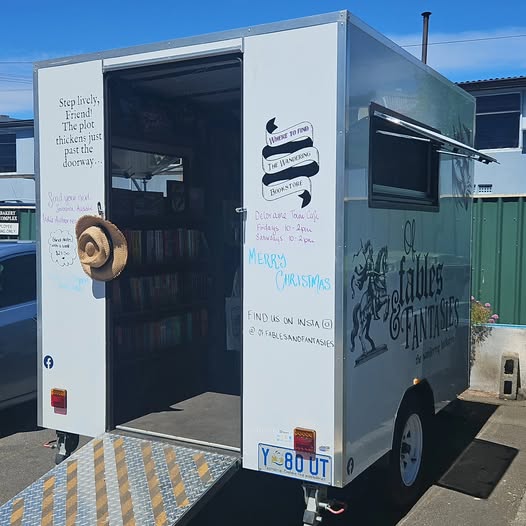
I went to see the owner of a wandering bookshop — think food van, think wheels, think the ability to turn up somewhere entirely unexpected and hand people a romance novel — because I had a perfectly reasonable question. Would she be interested in stocking my books? Simple. Businesslike. In and out.
I came home having promised to buy the whole thing.
I’m not entirely sure how. These things happen to me more than they probably should. The shop is called Of Fables and Fantasies, and I suspect the name didn’t help — once I heard it, some part of my brain had already decided this was mine. The rest of the conversation was just logistics.
So here we are.
For those of you keeping score at home, the current job description reads something like: romance novelist, publisher, blogger, small-scale farmer, cat wrangler (fifteen of them, don’t ask), and now — bookseller. I genuinely do not know who I am any more, but I’m having a very good time finding out.
Now here’s the part I’m especially excited about, and I want to talk about it properly before we take over because it matters to me. Really matters.
I want Of Fables and Fantasies to champion romance. And I want it to champion Australian romance writers.
Let me start with something that might surprise you if you’ve been living under a rock, or possibly just in Australian literary circles: romance is, by a significant margin, one of the biggest-selling genres on the planet. In 2024 alone, 51 million print units sold in the US market. Romance sales were up 24% year on year. Seven of the top ten books of the year were romance or romantasy titles. At many publishing houses, up to 70% of revenue comes from romance. The genre is not just surviving — it is carrying the book industry on its back, and has been for years.
And yet.
In Australia, romance gets shat on from a great height.
I’m going to say that plainly, because it’s true and it’s been true for as long as I’ve been writing, and I am tired of dancing around it. Romance authors are not considered writers. We are considered purveyors of smut. Our books are not shelved respectfully in literary fiction. They’re not reviewed seriously in the broadsheets. They don’t win the Miles Franklin. We are, at best, tolerated. At worst, openly mocked.
I know this from experience. When I did the first subject of my Bachelor of Creative Writing — which I completed in 2021, in my forties, surrounded by twenty-somethings — the professor asked each of us what we wanted to do with what we’d learn in the class. I listened to them all go around the room. They wanted to write poetry. Speculative fiction. Literary fiction. They were going to be the next Shakespeare. The next James Patterson. Grand ambitions, every one of them.
When it was my turn, I said I wanted to write romance.
The whole class laughed at me.
Not a polite chuckle. Actual laughter. Because I didn’t want to write real books, did I — I wanted to write those silly Mills and Boon things you buy at the supermarket. I sat there and I felt the embarrassment of it, that particular heat that comes from being the odd one out in a room full of people who think they know what good writing looks like.
And then my professor shut them up.
I don’t know why you laughed, she said. She’s the only one with realistic aims and knows where the money is.
I have never forgotten that. Not the laughter — or not only the laughter — but the fact that it took someone with authority in the room to make them stop. That says everything, doesn’t it? About who gets to decide what counts.
Here’s what I want to ask, though. George R. R. Martin writes explicit sex scenes. So does Cormac McCarthy. So does virtually every celebrated male literary author you can name. Their work is considered serious, important, literature. But a romance novel — which is largely written by women and largely read by women — is smut. The genre that outsells everything else on the shelf. Smut.
You’ll forgive me if I find that a little convenient.
Romance is not smut. Romance is rural and gritty and funny and heartbreaking. It is military and sports and contemporary and historical and supernatural and everything in between. It is romantasy with magic systems so intricate they’d make a fantasy purist weep with envy. It is chick lit that makes you snort-laugh on public transport. It is second-chance love stories and slow burns and found families and grief and hope and, yes, desire, because desire is part of being human and pretending otherwise is not literary sophistication — it is just snobbery.
I want Of Fables and Fantasies to be a place where that is understood.
I want rural romance on those shelves — stories set in the landscapes people around here actually live in. I want sports romance and military romance and contemporary romance and romantasy and chick lit and every flavour in between. And I want, wherever I possibly can, Australian authors. Writers who are here, working in this country, telling stories rooted in this place, and who deserve so much more recognition than they get.
Because here’s the thing about romance — about any fiction, really. Part of what it does, part of what it’s for, is letting readers feel themselves inside the story. And there is something that happens when you read a book and the landscape is yours. When the light looks right and the place names are familiar and the characters feel like people from your street, your town, your life. You’re not just reading about someone else falling in love. You’re falling in love in a place that belongs to you. Australian readers deserve that. They deserve to pick up a romance novel and find themselves in it — their country, their voice, their world — not just borrowed landscapes from somewhere else.
I’ll be honest with you. I don’t know how successful I’ll be at sourcing. I don’t know how many authors will want to be involved, whether logistics will cooperate, whether the universe will smile on me or laugh at me. But we are absolutely ready to give it a red hot shot, as we say in this part of the world.
If you’re an Australian romance author, or you know one, or you are one and you’re reading this with a slightly raised eyebrow — come find me. I want your books on my shelves. I want your stories rolling down Tasmanian roads in a little van with a beautiful name.
And if you just want to follow along and watch me figure out how to run a mobile bookshop while also writing novels and wrangling fifteen cats and growing vegetables and generally attempting to do everything at once — well. You’re very welcome here too.