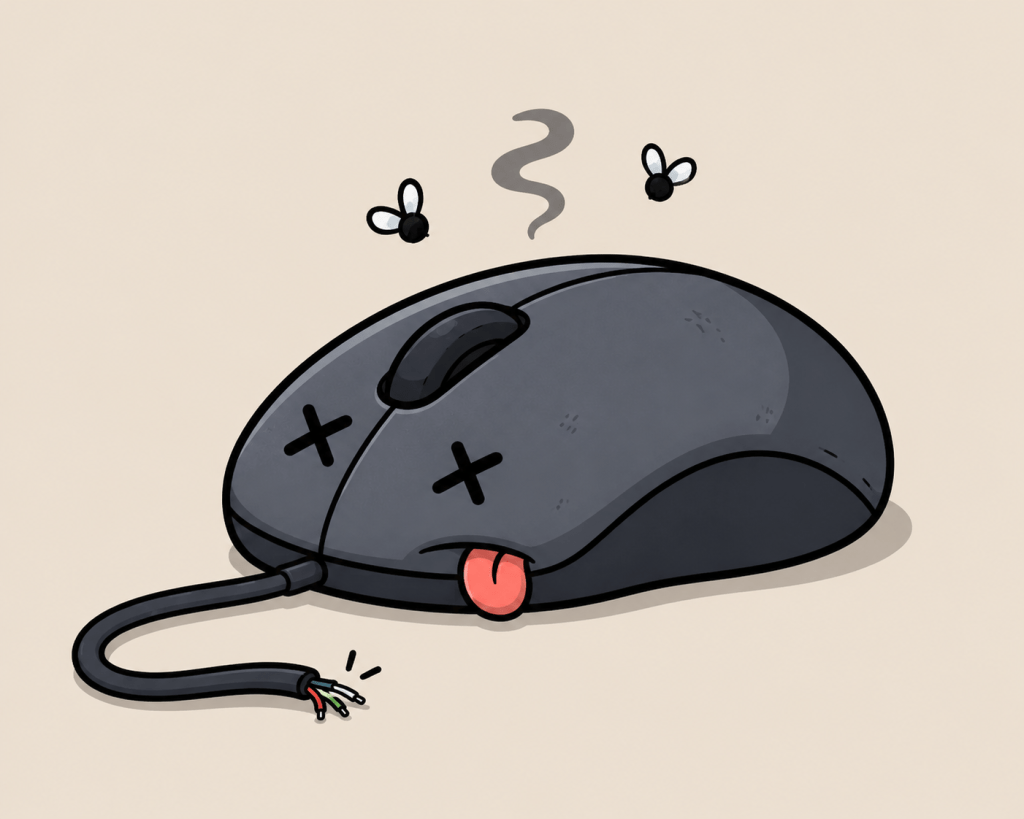
I have killed two mice this week.
Not the furry kind — although given that I live in rural Tasmania with fifteen cats, that particular tally is considerably higher and I accept no responsibility for it. I mean the small plastic kind. The kind with the little scroll wheel that is, as it turns out, not built to survive the editing habits of a romance novelist in the middle of a manuscript crisis.
The scroll wheel went first. Then the clicks became increasingly non-committal, the kind of performance where the mouse would technically register the click but in a way that suggested it was doing so under duress. And then, on mouse number two, I watched the scroll wheel spin freely and uselessly like a tiny hamster wheel that had seen things it could not unsee, and I knew it was over.
Two mice. One week.
In my defence, I have been editing.
Not in a pleasant, let’s-refine-the-prose kind of way. I mean deep-trench, where-did-that-paragraph-go, I-know-I-wrote-this-scene-but-I-cannot-locate-it-in-any-of-the-seventeen-iterations-of-this-document kind of editing. Some of my current manuscripts are on their fifth or sixth pass. What that means in practice is that I have taken scenes out and put them back in. I have moved chapters around like furniture in a room I’m never satisfied with. I have cut a beautiful paragraph because it slowed the pacing, grieved it, come back three days later and pasted it into a different chapter, realised it didn’t work there either, and the paragraph now lives in a document called good_bits_dont_delete.docx along with seventy-three other orphans.
The scroll wheel is the victim of all this frantic up-and-down-the-document activity. The endless hunting. The it was here a minute ago. The scrolling up to check a character’s eye colour because I’ve used three different shades across six drafts and I cannot be trusted with continuity.
Here is what nobody tells you about being deep in multiple series simultaneously: the books start to blur. Not in terms of characters — I know my characters the way I know my cats, which is to say completely and with great fondness and an awareness of exactly which ones will cause problems — but in terms of where things are. Which version has the scene. Which draft kept the subplot. Whether that line of dialogue was cut for length or moved to a later chapter or exists only in the document called backup_backup_REAL_backup_FINAL.docx.
The mice are paying the price for this structural chaos.
I have ordered replacements. Possibly two, on the theory that I might as well accept who I am as a person and an editor and plan accordingly. I am also looking, somewhat desperately, into better document management — because while I love the chaos of a novel in progress, the chaos of losing a novel inside itself is a different and less romantic experience.
If you’re a fellow writer who has also achieved the impressive feat of scrolling a mouse into an early grave, I would love to know I’m not alone. And if you have a genuinely foolproof system for tracking what you’ve moved, cut, or buried alive in a miscellaneous document — please, for the sake of the mice, tell me about it in the comments.
The cats, at least, are fine. Thriving, even. Possibly because they do not edit.
Suzy is a romance novelist writing as Bella Bruce, Avery Beckett, and KS Buckley. She lives in rural Tasmania with fifteen cats and an increasingly unreasonable number of half-finished manuscripts. She also runs Of Fables and Fantasies, a wandering mobile bookshop.

 thestationhousenotebook